Missouri Trailblazing
Your Guide to Missouri's Horse Trails and Camping
Basic Horse Camping Tips
 |
| Whether you camp in living quarters |
 |
| Or tent camp in some way |
 |
| Here are a few basic camping tips |
Equestrian camping is a very personal thing that varies widely from person to person depending on the equipment they can afford to own, their own level of comfort, their abilities, and their interests, so these tips are going to be a few “more generic” tips that I hope will be helpful and informative to all, whether you camp with a huge gooseneck horse trailer with fully customized living quarters or a two horse trailer and a tent. Some things are just always the same no matter what circumstances you camp in.
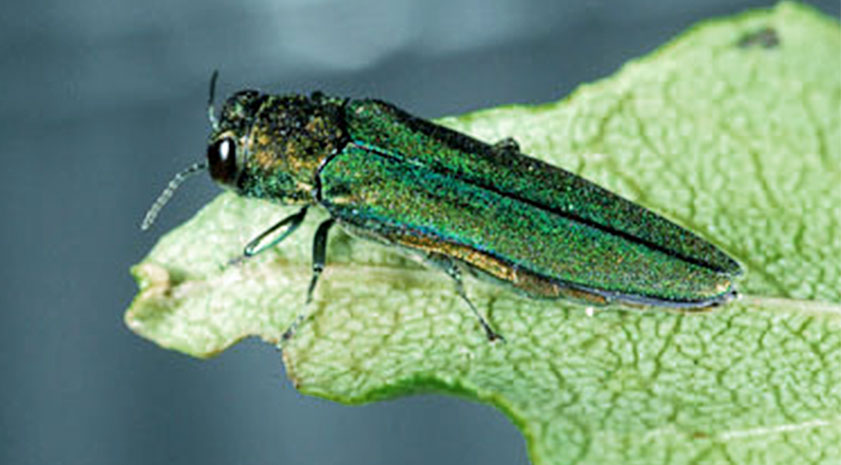 |
| Emerald Ash Borer |
 |
| Emerald Ash Borer Damage. They will kill trees. |
Due to the invasion of the Emerald Ash Borer, you should no longer bring your own firewood with you to camp. You may need to saddle up and ride a fair piece to collect firewood. Please do not chop down the live, close-by trees to use for firewood, or strip bark off of the standing trees for kindling. Live wood and kindling does not burn well. It’s wet and all you’ll get is a whole lot of smoke choking you for your effort. I have seen where people have done this at Cedar Creek Trail, in Boone and Callaway County, MO. If you do not know how to start a campfire easily, there are many books that can teach you how to do so. You can find a lot of them at the library, including boy scout handbooks. If you don‘t like to read, find a boy scout. They usually know, are quite good at it, and are normally happy to share their knowledge with you. You do not need to bring gasoline, kerosene, or use bar-b-que pit lighter fluid. Starting a campfire is easy if you use the right kind of wood and set it up the right way. These same books can also show you how to make fire starters out of different materials such as dryer lint or sawdust, egg cartons, and wax. These are great for starting a campfire when the wood is slightly damp from rain or if you can’t find anything to use for kindling.
Different campgrounds have or allow different ways for you to bed your horse down for the night. A few have open stall like enclosures to keep your horse in, but most have someplace where you can highline or picket line your horse. A few others have the room to set up electric fence enclosures or panel enclosures. If you have to, or choose to, highline or picket line your horse, know how to do so correctly and safely. Make sure you tie your line in such a way that you can tighten it when needed, that you know how to make a quick release knot that will keep your horse safely and securely tied to it, and keep your horses separated by a “horse length” so that they cannot easily turn butt to butt and start kicking each other. Train your horses, at home, how to stand quietly at a highline or picket line.
Then practice it a lot if they need it, before you try it out at the campground. The more practice they get, the better they will be at standing quietly without pawing, digging, or trying to aggravate their equine neighbor out of boredom.
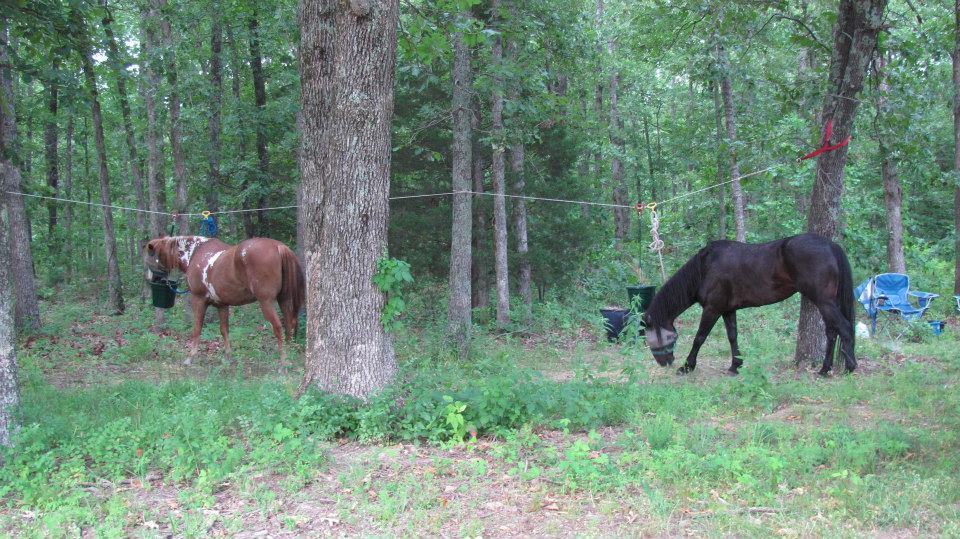 |
| Jinx and Flirt Highlined. |
Like many other people, Hank and I enjoy a couple of relaxing drinks around the campfire in the evening. We usually like wine coolers or maybe a simple mixed drink. If you enjoy drinking while you’re are camping, that’s great, but please refrain from getting “wasted”. Not only can you make a fool out of yourself if you’re plastered, it’s a safety issue. I was at a campground one time when two horses got tangled up with each other, their lead ropes, and the poorly made highline. Their owner was too drunk to notice it, let alone do anything to help them. Luckily neighboring campers saw the wreck in progress and went over to take care of the situation, but it should have been noticed and handled by the owner. In other instances we’ve seen too much alcohol make people belligerent, looking for a fight, or abusive to their horse, doing things I’m sure they wouldn’t have done if they hadn’t had too much to drink. I’m not writing about this because I’m a prude or because I have a
A few other things you can bring, that I must confess, I have often forgotten in the past too: Shovel and rake to keep horse area clean, a broom, insect repellent, duct tape, wasp spray (can be used if there is a small nest in the outhouse. Please use with caution and common sense. Do NOT try to spray a huge hornet‘s nest or yellow jacket nest), more ice than you think you need, and a pocketknife (I know that seems obvious, but I’m surprised how many people don’t carry one, especially women).
 Missouri Trailblazing